Price of Solar Panel for Home in Jharkhand with Subsidy Details
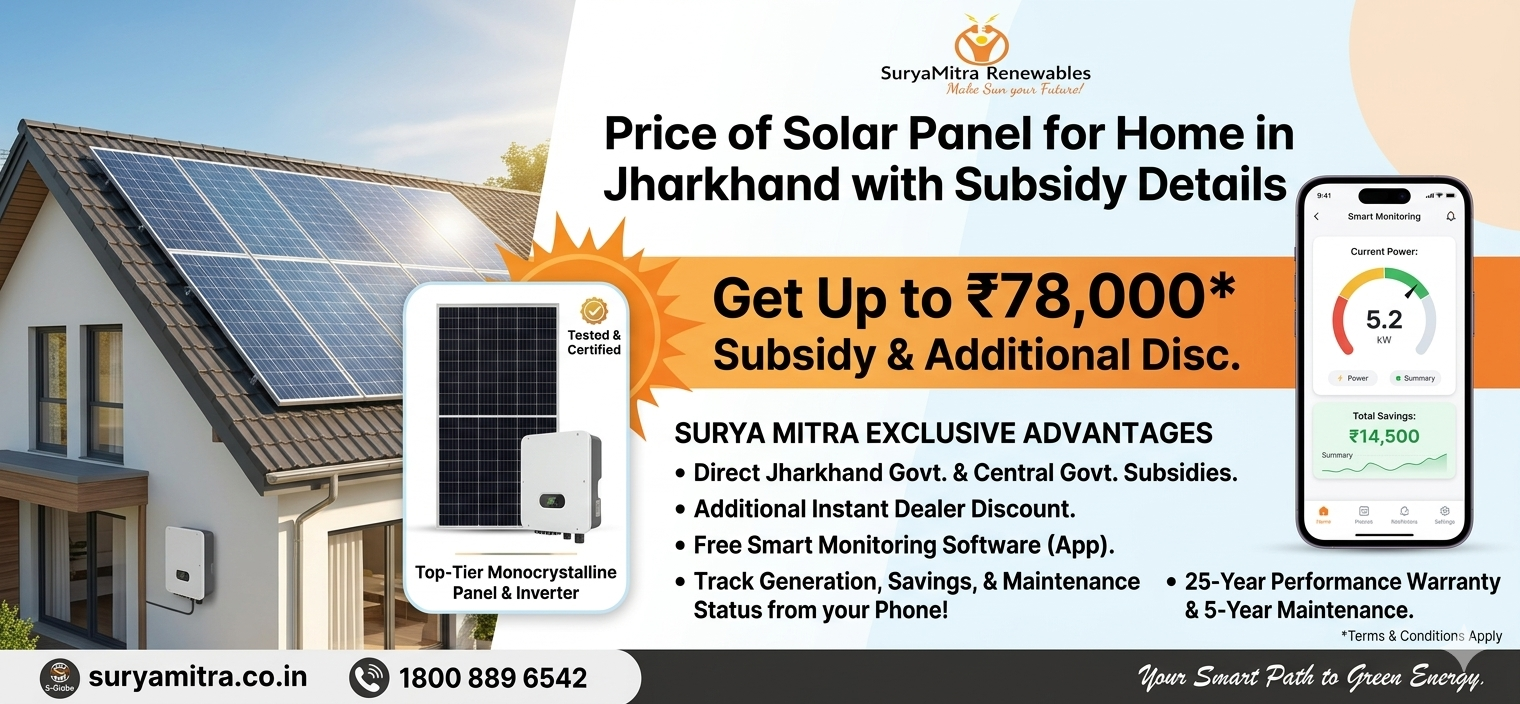
Save up to ₹78,000 via PM Surya Ghar Subsidy. See cost vs. savings for Ranchi & Jamshedpur.
The transition toward renewable energy in Jharkhand has reached an unprecedented momentum in 2026. As the state moves to decentralize power generation, residential rooftop solar systems have emerged as the most viable solution for homeowners in cities like Ranchi, Jamshedpur, Dhanbad, and Bokaro. We have observed a significant shift in the energy landscape, driven by the dual force of decreasing hardware costs and substantial government incentives. For any household aiming to eliminate the price of solar panel for home in Jharkhand electricity bills while contributing to a greener future, understanding the financial architecture of a solar investment is essential.
In Jharkhand, the feasibility of solar energy is exceptionally high due to the region's geographic positioning, which allows for approximately 300 days of clear sunshine annually. We have seen that a well-designed solar photovoltaic (PV) system can effectively neutralize monthly utility expenses, transforming a recurring liability into a long-term asset. The current market dynamics are influenced by the technological transition from older polycrystalline modules to high-efficiency Mono PERC and TOPCon panels, which offer superior performance even in the high-temperature conditions typical of Jharkhand’s summers.
The price of solar panel for home in Jharkhand is determined by several variables, including the total system capacity, the type of inverter used (Grid-tied, Off-grid, or Hybrid), and the structural complexity of the rooftop. In 2026, the market has stabilized, offering homeowners a predictable investment window. For a standard residential setup, the comprehensive cost includes the PV modules, the mounting structure (designed to withstand local wind speeds), DC/AC wiring, earthing systems, and professional installation charges. While the upfront cost for a 1kW system remains the entry point for small households, we recommend a 3kW system for most average-sized homes. This capacity is often considered the "sweet spot" because it maximizes the available government subsidies while covering the load requirements of typical appliances, including fans, lights, refrigerators, and small air conditioning units. The price per kilowatt typically decreases as the system size increases, thanks to economies of scale in logistics and labor.
When evaluating the solar pv panel price in jharkhand, it is vital to distinguish between the various technologies available in the local market. The choice of technology directly impacts the ROI (Return on Investment) and the physical footprint required on your roof.
Beyond the panels, the balance of system (BOS) components—such as lightning arrestors and bi-directional net meters—plays a crucial role in the final pricing. The net metering policy in Jharkhand allows homeowners to "bank" excess energy with the DISCOM (like JBVNL), which is then credited against their nighttime or monsoon consumption.
The financial burden on Jharkhand residents is significantly alleviated by the PM Surya Ghar: Muft Bijli Yojana. This central scheme provides a robust financial assistance model that makes solar adoption accessible to the middle class. The subsidy is structured to favor smaller residential installations to encourage mass adoption.
To claim these benefits in Jharkhand, we must follow the official process via the National Portal for Rooftop Solar. This involves:
The subsidy is transferred to the user's bank account via Direct Benefit Transfer (DBT).
One of the most frequent questions we encounter regarding the price of solar panel for home in Jharkhand is the hidden cost of maintenance. Fortunately, solar PV systems are solid-state technology with no moving parts. In the dusty environments of the industrial belts in Jharkhand, the primary maintenance requirement is regular cleaning of the panels—typically every 15 days—to ensure maximum light absorption. Most modern systems installed in 2026 come with remote monitoring capabilities, allowing us to track performance in real-time via smartphone applications.
Investing in a solar power plant for your home in Jharkhand is no longer just an environmental choice—it is a sophisticated financial strategy. By leveraging the solar pv panel price in jharkhand alongside the current central subsidies, homeowners can achieve a payback period of just 4 to 5 years. For the remaining 20 years of the system's life, the electricity generated is essentially free. We believe that with the current 2026 policy framework, there has never been a more opportune time to transition to a clean, autonomous, and cost-effective energy solution know more.
Q1: How much roof space is required for a 3kW solar system in Jharkhand?
A1: For a 3kW system using high-efficiency panels, you will need approximately 250 to 300 square feet of shadow-free area. In Jharkhand, we ensure panels are south-facing to capture the maximum solar radiation.
Q2: Does the subsidy apply to off-grid solar systems?
A2: Current government subsidies under the PM Surya Ghar Yojana are specifically designed for grid-connected (On-grid) systems that utilize net-metering. Off-grid systems involving heavy battery backups are generally not covered under the central CFA.
Q3: What is the lifespan of the solar PV panels installed?
A3: The high-quality PV modules used in modern installations come with a performance warranty of 25 years. Most panels will still produce about 80% of their original capacity even after two and a half decades.
Q4: How long does it take to receive the subsidy in Jharkhand?
A4: Once the net meter is installed and the commissioning certificate is generated on the portal, the subsidy is usually credited via DBT to the registered bank account within 30 to 45 days.
Q5: Can I run an Air Conditioner (AC) on a home solar system?
A5: Yes, a system of 3kW or higher is capable of supporting a 1.5-ton inverter AC during the day. Through net-metering, the energy produced during the day offsets the power used by the AC at night.